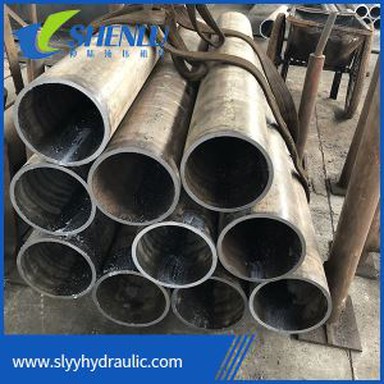
Induction Hardened vs Chrome Plated Piston Rods: What Are the Differences?
Mar 22, 2026
One of the most common misunderstandings in the hydraulic industry is the assumption that induction hardened piston rods and chrome plated piston rods are competing products.
They usually are not.
In fact, many high-quality hydraulic cylinder rods are both induction hardened and hard chrome plated.
The confusion is understandable because suppliers often advertise one feature more prominently than the other. Buyers then start asking questions such as:
- Is induction hardening better than chrome plating?
- Can chrome plating replace induction hardening?
- Which option gives a longer service life?
After manufacturing piston rods for construction equipment, industrial hydraulics, mining machinery, and agricultural equipment, we've found that the real question is different:
What problem are you trying to solve-wear, corrosion, impact loading, or all three?
Understanding that distinction makes material selection much easier.
The Short Answer
Think of a piston rod as having two jobs.
The surface must resist wear, corrosion, and seal damage.
The core must withstand bending, impact, and repeated hydraulic loading.
Induction hardening strengthens the surface layer of the steel itself.
Hard chrome plating adds a hard chromium coating on top of the steel surface.
These processes work together rather than replacing one another.
What Is an Induction Hardened Piston Rod?
Induction hardening is a heat-treatment process.
An electrical induction coil rapidly heats the outer layer of the rod, and the surface is then quenched. The result is a hard wear-resistant case with a tough ductile core underneath.
Typical characteristics include:
Surface hardness: 50–60 HRC
Hardened depth: 1–5 mm depending on rod diameter and specification
Excellent fatigue resistance
Improved resistance to denting and surface deformation
Strong load-carrying capability under repeated hydraulic cycles
For large cylinders subjected to heavy impact loads, the hardened layer is often one of the most important contributors to long-term durability.
What Is a Hard Chrome Plated Piston Rod?
Hard chrome plating is an electroplating process that deposits a layer of chromium onto the rod surface.
Typical characteristics include:
- Chrome hardness: 850–1100 HV
- Coating thickness: 20–50 μm for most hydraulic applications
- Excellent corrosion resistance
- Low friction surface
- Reduced seal wear
- Improved surface finish
The chrome layer is relatively thin compared with the induction-hardened case, but it provides outstanding protection against corrosion and abrasive wear.
The Key Difference: Surface Layer vs Surface Coating
| Induction hardening | Heat treatment |
| What changes? | Steel microstructure |
| Depth affected | Millimeters |
| Main benefit | Load & fatigue resistance |
| Hard chrome plating | Coating |
| What changes? | Surface coating |
| Depth affected | Microns |
| Main benefit | Corrosion & seal performance |
One process changes the steel itself. The other adds a protective coating on top of the steel.
That is why the best hydraulic piston rods often use both.
Why Many Premium Piston Rods Use Both
A customer once asked why we recommended an induction hardened chrome plated rod instead of a standard chrome plated bar for a large excavator cylinder.
The answer became clear after reviewing the operating conditions.
The cylinder experienced:
High hydraulic pressure
Frequent shock loading
Outdoor operation
Mud and abrasive contamination
Long daily operating hours
In that environment, chrome plating alone would provide corrosion resistance, but the underlying steel surface could still deform under repeated heavy loading.
Induction hardening created a hard supporting layer beneath the chrome, allowing the rod to maintain surface integrity while the chrome protected against corrosion and seal wear.
This combination is now common in construction, mining, and heavy industrial hydraulics.
When Is Chrome Plating Alone Enough?
Not every hydraulic cylinder requires induction hardening.
For many applications, a hard chrome plated CK45 rod is entirely sufficient.
Examples include:
- Forklifts
- Scissor lifts
- Agricultural machinery
- Injection molding machines
- General industrial cylinders
- Material handling equipment
These systems typically operate under moderate loads where the base material already provides adequate strength.
Adding induction hardening may increase cost without providing a meaningful improvement in service life.
When Is Induction Hardening Essential?
Induction hardening becomes much more important when cylinders are exposed to:
- Heavy impact loading
- High cyclic stress
- Large rod diameters
- Long strokes with bending loads
- Mining or construction environments
- Press and forging equipment
- Offshore or heavy-duty hydraulic systems
In these applications, the hardened case significantly improves fatigue life and resistance to surface damage.
The Failure That Changes Most Buyers' Minds
We once inspected a piston rod that had developed a deep groove after abrasive contamination entered the cylinder.
The rod was chrome plated but not induction hardened.
Once the chrome layer was breached, the softer substrate wore rapidly, accelerating seal failure.
A comparable induction hardened chrome plated piston rod would not have been immune to damage, but the hardened substrate would have provided much better resistance after the coating was compromised.
That distinction is often overlooked during purchasing.
Many failures begin after the chrome layer has been damaged, not before.
Cost vs Service Life
From a purchasing perspective, the comparison usually looks like this:
Hard Chrome Plated Rod
- Lower cost
- Excellent corrosion resistance
- Good wear resistance
- Suitable for most standard hydraulic applications
Induction Hardened Chrome Plated Rod
- Higher cost
- Excellent corrosion resistance
- Excellent wear resistance
- Superior fatigue performance
- Better resistance to impact and deformation
- Longer service life in severe-duty applications
For light-duty cylinders, the standard chrome plated rod often delivers the best value.
For heavy-duty cylinders, the induction hardened version usually becomes less expensive over the life of the machine because it reduces downtime and replacement frequency.
How We Recommend the Right Rod
At Wuxi Shenlu Hydraulic Machine Parts Co., Ltd., customers frequently ask whether they should specify CK45 hard chrome plated rods, 4140 chrome plated bars, or 42CrMo induction hardened rods.
Rather than starting with the material, we evaluate:
- Working pressure
- Impact loading
- Stroke length
- Corrosion environment
- Expected service life
- Maintenance interval
- Budget constraints
In many industrial applications, a hard chrome plated CK45 piston rod is the most economical and reliable solution.
For severe-duty equipment, we often recommend induction hardened chrome plated rods using 4140 steel or 42CrMo steel to maximize fatigue strength and wear resistance.
The goal is not to sell the most expensive rod. It is to select the rod that delivers the best performance over the machine's actual operating life.
Final Thoughts
Induction hardened piston rods and chrome plated piston rods are not opposing technologies.
They solve different problems.
Induction hardening strengthens the steel surface and improves fatigue resistance.
Hard chrome plating protects the surface against corrosion, wear, and seal damage.
For many standard hydraulic cylinders, hard chrome plating alone is sufficient.
For demanding applications involving heavy loads, impact, or severe operating conditions, induction hardened chrome plated rods often provide the longest and most reliable service life.
The best choice depends on the application-not on which process sounds more advanced.
In hydraulic engineering, durability is rarely achieved through a single treatment. It is achieved by combining the right material, the right heat treatment, the right surface protection, and the right manufacturing process into one reliable piston rod.