How Does Mounting Position Affect Hydraulic Cylinder Selection?
Aug 09, 2026
When selecting a hydraulic cylinder, bore, stroke, and working pressure are usually the first specifications buyers consider. But for a working cylinder, mounting position is just as important as hydraulic force.
The cylinder may be installed vertically, horizontally, or at an angle. Its mounting points may also be fixed, articulated, or required to accommodate angular movement. These conditions affect piston rod loading, cylinder alignment, buckling risk, installation length, and service life.
For custom hydraulic cylinders, the mounting arrangement should therefore be considered before the final cylinder dimensions are determined.
How Does Mounting Position Affect Hydraulic Cylinder Selection?
The mounting position determines how the cylinder transfers force to the machine.
A correctly aligned cylinder mainly works along its centerline. When the mounting arrangement creates an offset or angular load, the piston rod can experience additional bending or side loading.
This can affect:
- Piston rod diameter
- Cylinder stroke
- Mounting type
- Rod stability
- Cylinder alignment
- Guide and seal wear
- Overall cylinder dimensions
This is why two hydraulic cylinders with the same bore and pressure may require different designs when installed on different machines.
Vertical Hydraulic Cylinder Installation
Vertical mounting is common in lifting equipment, industrial machinery, presses, and material handling systems.
The main consideration is the direction of the load relative to the cylinder.
For example, a cylinder lifting a load upward may work mainly in compression, while another application may require the rod to pull a suspended component downward.
The supplier needs to know:
- Load weight
- Load direction
- Working pressure
- Stroke
- Mounting center distance
- Whether the load is externally guided
For long-stroke hydraulic cylinders working under compression, piston rod stability becomes particularly important. A larger rod diameter may be required depending on the unsupported length and mounting arrangement.
Horizontal Hydraulic Cylinder Installation
Horizontal cylinders are widely used for pushing, positioning, clamping, opening, and material handling.
The main concern is often side loading.
If the machine mechanism does not guide the moving component independently, the piston rod may be forced to carry lateral loads. Continuous side loading can accelerate wear on the rod guide, seals, and cylinder bore.
For this reason, a horizontal hydraulic cylinder should not be selected only according to the required pushing force.
The supplier should also understand whether the machine has:
- External linear guides
- Parallel guide rails
- Linkage mechanisms
- Offset loads
- Lateral forces during operation
Where substantial side loading exists, an external guide is normally preferable to using the hydraulic cylinder as the guide member.
Angled Mounting and Linkage Mechanisms
Many hydraulic cylinders are not installed parallel to the direction of movement.
This is common in:
- Construction machinery
- Agricultural equipment
- Dump bodies
- Tilting equipment
- Gates and doors
- Material handling systems
In these applications, the cylinder force acts through a linkage.
The effective mechanical force therefore depends on the cylinder angle and the geometry of the mounting points.
As the cylinder extends, the angle may also change. This means that the cylinder can experience different mechanical conditions at different points in its stroke.
For a custom hydraulic cylinder, the supplier should ideally receive the mounting dimensions or a machine drawing showing the cylinder's movement range.
How Does Mounting Position Affect Piston Rod Selection?
Mounting position is closely related to piston rod selection.
A piston rod working mainly in tension may have different requirements from one working in compression. A long rod under compression has a greater risk of buckling, especially when the cylinder has a long stroke.
The rod diameter should therefore be evaluated according to:
Load + Stroke + Mounting Distance + Load Direction + Mounting Support
At Slyy Hydraulic, piston rods are one of the main components used in hydraulic cylinder manufacturing. Rod selection can therefore be considered together with the complete cylinder design rather than treating the rod as an isolated standard component.
For applications requiring higher wear or corrosion resistance, piston rod material and surface treatment also need to be specified according to the working environment.
How Does Mounting Affect Hydraulic Cylinder Tube Selection?
Mounting conditions also affect the requirements for the cylinder tube.
The cylinder tube must maintain accurate internal dimensions and a suitable bore surface for piston and seal movement. This becomes particularly important when the cylinder operates with long strokes, high pressure, or demanding cycle requirements.
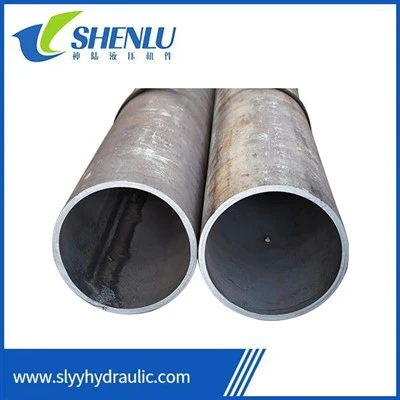
Slyy Hydraulic works with cold drawn tubes and honed tubes for hydraulic cylinder applications. The bore condition, dimensional accuracy, straightness, and surface finish of the tube are important because they directly influence piston movement and sealing performance.
For a custom cylinder, the tube should therefore be considered together with the piston, seals, and piston rod rather than specified only by nominal outside diameter.
Why Is Cylinder Alignment Important?
Regardless of whether the cylinder is mounted vertically or horizontally, alignment should be checked throughout the complete stroke.
Poor alignment can create continuous side loading even when the calculated hydraulic force is sufficient.
Check whether:
- The mounting points remain aligned during operation
- The load moves along the intended path
- The cylinder has enough angular freedom
- The mounting joint can accommodate movement
- External guides carry lateral loads
- The piston rod remains properly supported
For articulated mechanisms, clevis, spherical eye, trunnion, or other suitable mounting arrangements may be required.
How Does Mounting Position Affect Stroke and Installation Length?
Stroke is only one part of the installation dimension.
The buyer should also consider:
- Retracted length
- Extended length
- Mounting center distance
- Available installation space
- Clearance around the piston rod
- Movement angle
- Position of hydraulic ports
For linkage applications, changing the mounting points can change the required cylinder stroke even when the machine's final movement remains the same.
This is why Slyy Hydraulic can work from mounting dimensions or technical drawings when a standard cylinder does not directly match the machine installation.
What Hydraulic Cylinder Mounting Types Are Common?
The appropriate mounting style depends on how the cylinder connects to the machine.
Common configurations include:
- Clevis mounting
- Flange mounting
- Trunnion mounting
- Foot mounting
- Cross-tube mounting
- Spherical eye mounting
- Threaded mounting
A fixed mounting may require more accurate alignment, while an articulated mounting can allow controlled angular movement.
The mounting type should be selected together with the machine's movement rather than simply according to what is easiest to install.
What Should Buyers Send to a Hydraulic Cylinder Manufacturer?
For a custom hydraulic cylinder, a mounting drawing is often more useful than a simple product description.
At minimum, provide:
| Parameter | Information |
|---|---|
| Cylinder type | Single acting or double acting |
| Mounting position | Vertical, horizontal, or angled |
| Mounting type | Clevis, flange, trunnion, etc. |
| Bore | Required bore diameter |
| Stroke | Required working stroke |
| Working pressure | Normal operating pressure |
| Load | Load and load direction |
| Rod diameter | Required or supplier-designed |
| Retracted length | Mounting center distance |
| Extended length | Mounting center distance |
| Port | Size, thread, and location |
| Side load | Expected lateral load |
| Working environment | Temperature, dust, moisture, corrosion, etc. |
| Quantity | Required order quantity |
If the cylinder is part of a linkage, include a drawing showing the mounting points and the movement angle.
This allows the cylinder manufacturer to evaluate the actual mechanical conditions instead of sizing the cylinder from bore and pressure alone.
How Slyy Hydraulic Approaches Custom Hydraulic Cylinder Selection
At Slyy Hydraulic, hydraulic cylinder selection can be connected with the components that determine cylinder performance, including honed tubes, cold drawn tubes, and piston rods.
This is useful for buyers who need more than a standard cylinder specification.
For example, a custom cylinder may require a specific:
- Honed tube bore tolerance
- Internal surface finish
- Piston rod diameter
- Piston rod material
- Rod surface treatment
- Mounting dimension
- Stroke length
- Port configuration
By considering these components together, the hydraulic cylinder can be designed around the actual machine installation rather than simply adapting a standard cylinder to the equipment.
Final Consideration
Mounting position affects much more than where a hydraulic cylinder is physically installed.
It influences load direction, side loading, piston rod stability, cylinder alignment, stroke, mounting dimensions, and component selection.
For buyers ordering custom hydraulic cylinders, the most useful information is not simply "100 mm bore and 500 mm stroke." The manufacturer should understand how the cylinder is installed, what load it carries, how the machine moves, and whether the cylinder is exposed to side loading or compression.
With the mounting conditions clearly defined, the cylinder bore, piston rod, honed tube, mounting configuration, and other components can be selected as one complete system.