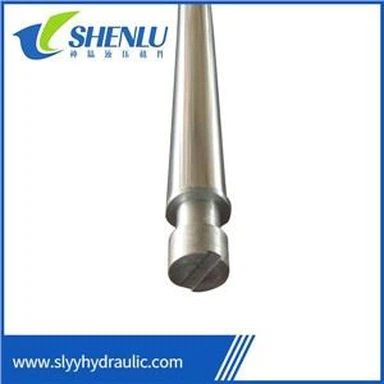
CK45 vs 4140 vs 42CrMo: Which Material Is Better for Piston Rods?
Mar 08, 2026
One question comes up repeatedly when discussing hydraulic cylinder rods with overseas customers:
"Should we upgrade from CK45 to 4140?"
Sometimes the question is asked differently:
"42CrMo has higher strength. Does that mean it will give us a longer service life?"
At first glance, the answer seems obvious. If one steel has higher tensile strength, it should perform better.
But after manufacturing hard chrome plated rods and induction hardened piston rods for customers in construction machinery, mining equipment, agricultural machinery and industrial hydraulics, we've learned that the strongest material is not always the best material.
In fact, we've seen hydraulic cylinders made from premium alloy steel fail long before standard CK45 piston rods.
The reason?
The failure had nothing to do with the steel grade.
Instead, it was caused by poor surface hardness, insufficient chrome plating thickness, improper heat treatment, or unsuitable material selection for the actual application.
Choosing between CK45 steel, 4140 steel, and 42CrMo steel isn't about selecting the material with the highest numbers on a data sheet. It's about understanding how each material behaves in real working conditions.
Why There Is No "Best" Piston Rod Material
Many buyers expect engineers to recommend one material for every project.
Unfortunately, hydraulic engineering doesn't work like that.
A hydraulic cylinder used on a warehouse forklift experiences completely different loading conditions from one installed on an excavator or a forging press.
Some cylinders work continuously under moderate pressure.
Others experience heavy impact loads every few seconds.
Some operate indoors in clean factories.
Others spend years in mud, seawater, dust, or extreme temperatures.
Expecting one steel grade to perform best in every situation simply isn't realistic.
That's why experienced hydraulic manufacturers start with the application-not the material.
Understanding the Three Materials
Although these three steels are commonly compared, they were developed with different priorities.
CK45 Steel
CK45 steel is a medium-carbon steel that has become the industry standard for many hydraulic cylinder rods.
It offers an excellent balance between:
- Mechanical strength
- Machinability
- Surface finishing
- Cost
- Availability
Because it machines easily and responds well to induction hardening and hard chrome plating, CK45 remains the first choice for standard hydraulic cylinders worldwide.
4140 Steel
4140 steel is a chromium-molybdenum alloy steel.
Compared with CK45, it provides:
- Higher tensile strength
- Better fatigue resistance
- Improved hardenability
- Better impact performance
These advantages become valuable in heavy-duty hydraulic equipment where piston rods experience repeated shock loading.
42CrMo Steel
From a performance perspective, 42CrMo steel is very similar to 4140.
It is widely specified in Europe and Asia for heavy engineering equipment, mining machinery and large hydraulic systems.
After proper heat treatment, 42CrMo delivers excellent toughness together with outstanding wear resistance.
Looking Beyond the Strength Numbers
Many purchasing decisions begin with a mechanical property table.
Here's a simplified comparison.
| Material | CK45 | 4140 | 42CrMo |
| Tensile Strength | Medium | High | Very High |
| Yield Strength | Medium | High | Very High |
| Hardenability | Good | Excellent | Excellent |
| Fatigue Resistance | Good | Excellent | Excellent |
| Machinability | Excellent | Good | Good |
| Material Cost | Lower | Higher | Higher |
Looking only at the table, choosing 42CrMo seems obvious.
But here's something many specification sheets don't tell you.
For a standard hydraulic cylinder operating below its design load, increasing tensile strength from 700 MPa to 1000 MPa often produces little measurable improvement in service life.
Other factors usually become the limiting factor first.
What Actually Causes Most Piston Rod Failures?
Several years ago, one customer contacted us because the chrome layer on several piston rods had begun peeling after less than twelve months.
They immediately suspected the material.
The rods were manufactured from CK45.
Their first request was simple:
"Can we replace CK45 with 4140?"
Before discussing material upgrades, we reviewed the failed components.
The investigation revealed something unexpected.
The base steel remained completely sound.
The problem came from insufficient surface preparation before chrome plating.
Changing to a stronger alloy steel would not have prevented the failure.
We've encountered similar situations many times.
When piston rods fail, the most common causes include:
- Poor chrome adhesion
- Insufficient induction hardening depth
- Incorrect surface roughness
- Seal contamination
- Corrosion caused by damaged chrome
- Misalignment inside the hydraulic cylinder
The steel grade itself is often not the primary reason.
That's why experienced engineers evaluate the entire manufacturing process before recommending a different material.
When Is CK45 the Better Choice?
Despite the popularity of alloy steels, CK45 piston rods remain the preferred solution for many hydraulic applications.
Typical examples include:
- Agricultural machinery
- Forklifts
- Scissor lifts
- Injection molding machines
- Industrial hydraulic cylinders
- Material handling equipment
- Standard engineering machinery
Why?
Because CK45 already provides sufficient strength while offering lower machining costs and excellent surface finishing.
For these applications, upgrading to 4140 may increase costs without delivering meaningful performance improvements.
When Does 4140 or 42CrMo Make Sense?
There are situations where alloy steels clearly justify the additional investment.
For example:
Mining cylinders subjected to continuous impact loading.
Offshore hydraulic equipment exposed to harsh environments.
Large construction machinery carrying extremely heavy loads.
Forging presses operating under repeated high-pressure cycles.
Metallurgical equipment where fatigue resistance becomes critical.
In these applications, the superior hardenability and toughness of 4140 steel or 42CrMo steel can significantly improve reliability and reduce long-term maintenance costs.
The key point is that the operating conditions-not the material price-should drive the decision.
Material Is Only One Part of a High-Quality Piston Rod
One misconception we often encounter is that buying premium steel automatically guarantees a premium piston rod.
In reality, every hydraulic cylinder rod undergoes multiple manufacturing stages after the raw material arrives.
These include:
- Straightening
- Precision turning
- Induction hardening
- Centerless grinding
- Hard chrome plating
- Super finishing
- Dimensional inspection
A poorly manufactured 42CrMo piston rod may perform worse than a well-produced CK45 hard chrome plated rod.
That's why experienced hydraulic manufacturers invest just as heavily in process control as they do in raw materials.
How We Help Customers Choose the Right Material
At Wuxi Shenlu Hydraulic Machine Parts Co., Ltd., customers often ask us which material we recommend for their piston rods.
Our answer always starts with another question:
"What will the cylinder actually do?"
Instead of automatically recommending the highest-grade steel, we evaluate:
- Maximum working pressure
- Dynamic and impact loading
- Stroke length
- Operating environment
- Corrosion requirements
- Heat treatment requirements
- Budget and expected service life
For many industrial hydraulic cylinders, a CK45 hard chrome plated rod provides the most economical and reliable solution.
For heavy-duty applications, we also manufacture 4140 chrome plated bars, 42CrMo piston rods, and induction hardened chrome plated rods designed for demanding operating conditions.
Our goal isn't to sell the most expensive material-it's to help customers select the material that delivers the best long-term performance for their specific application.
Final Thoughts
Comparing CK45 vs 4140 vs 42CrMo isn't about identifying a single winner.
Each material has its strengths.
CK45 steel offers outstanding value, excellent machinability, and dependable performance for most standard hydraulic cylinder rods.
4140 steel provides higher fatigue strength and greater toughness for demanding industrial applications.
42CrMo steel excels in heavy-duty equipment where high strength and impact resistance are essential.
The most successful hydraulic projects don't begin by asking, "Which material is strongest?"
They begin by asking, "What does this piston rod need to survive?"
Once that question is answered, choosing the right material becomes much simpler-and far more cost-effective.
For hydraulic equipment manufacturers, selecting the appropriate piston rod material is only the first step. Consistent heat treatment, precision machining, induction hardening, and high-quality chrome plating ultimately determine whether a piston rod delivers years of reliable service or becomes an expensive maintenance problem.